

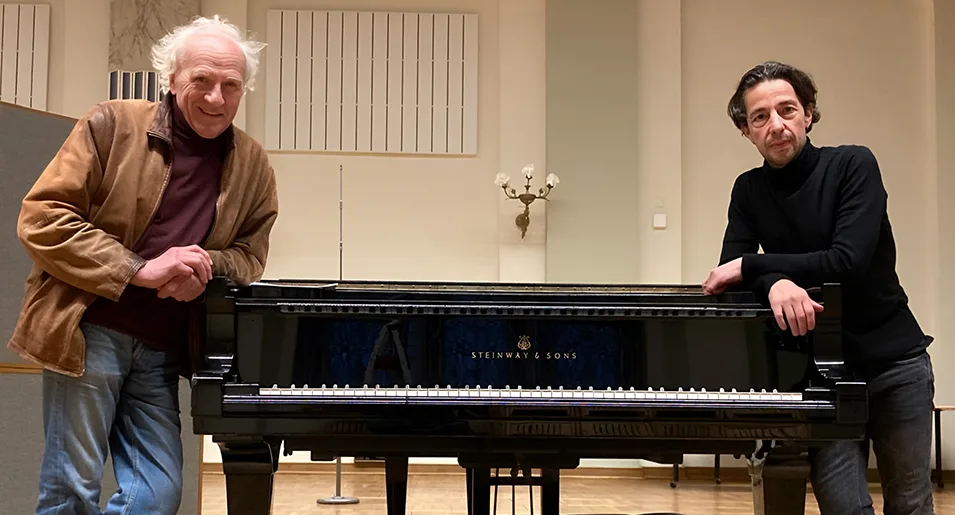
“These are times when art cannot wander far from politics, whether one wishes it or not. It need not be an illustration of war, but the reflection itself is present,” says Vladimiras Tarasovas.
On June 7, two distinguished Lithuanian artists return to Paliesius Manor—the captivating pianist Viktoras Paukštelis and the world-renowned drummer and jazz virtuoso Vladimiras Tarasovas. They will present a program to the audience where Baroque music and contemporary improvisation converge. The concert will also feature the manor’s new antique instruments—the organ and the harpsichord.
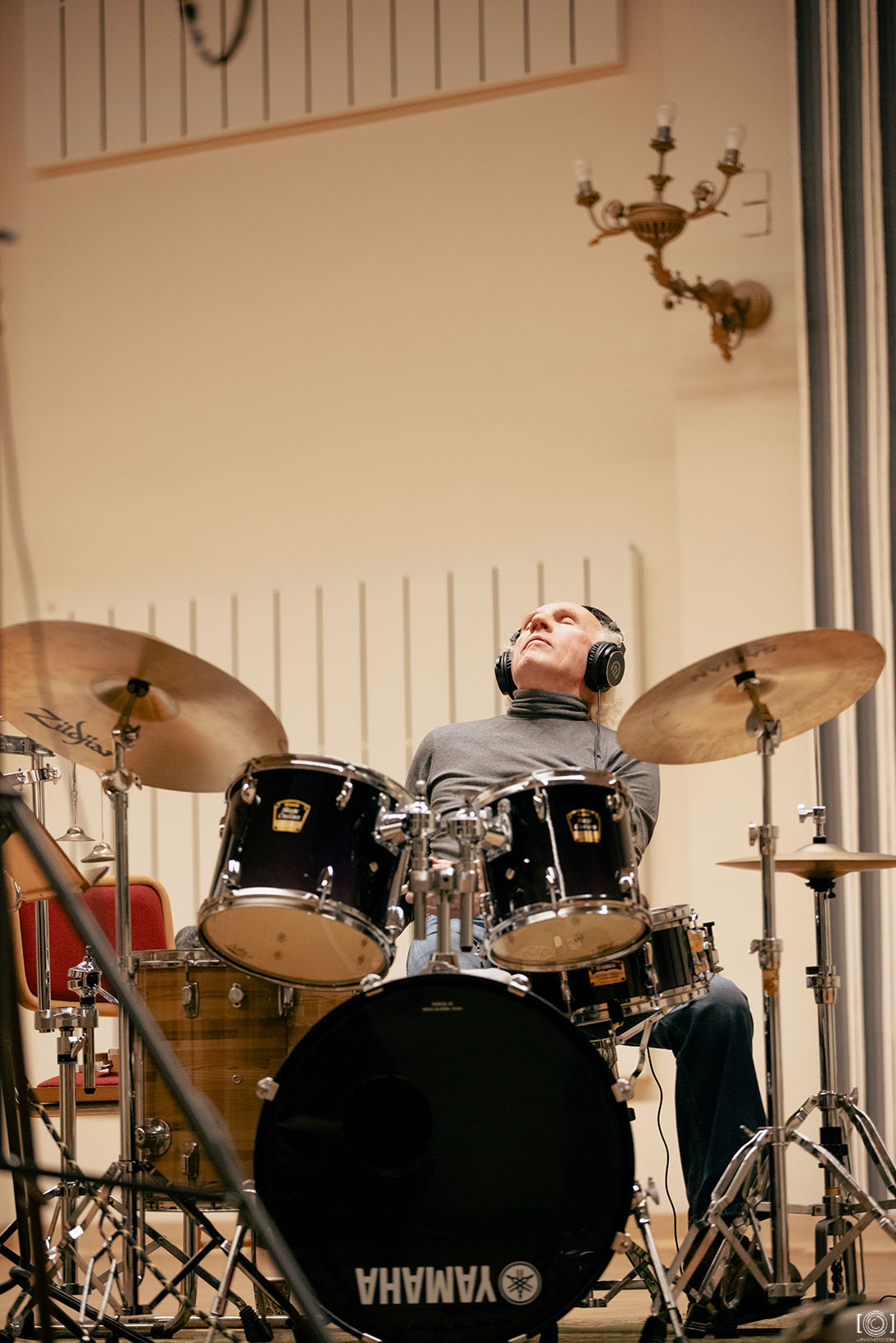
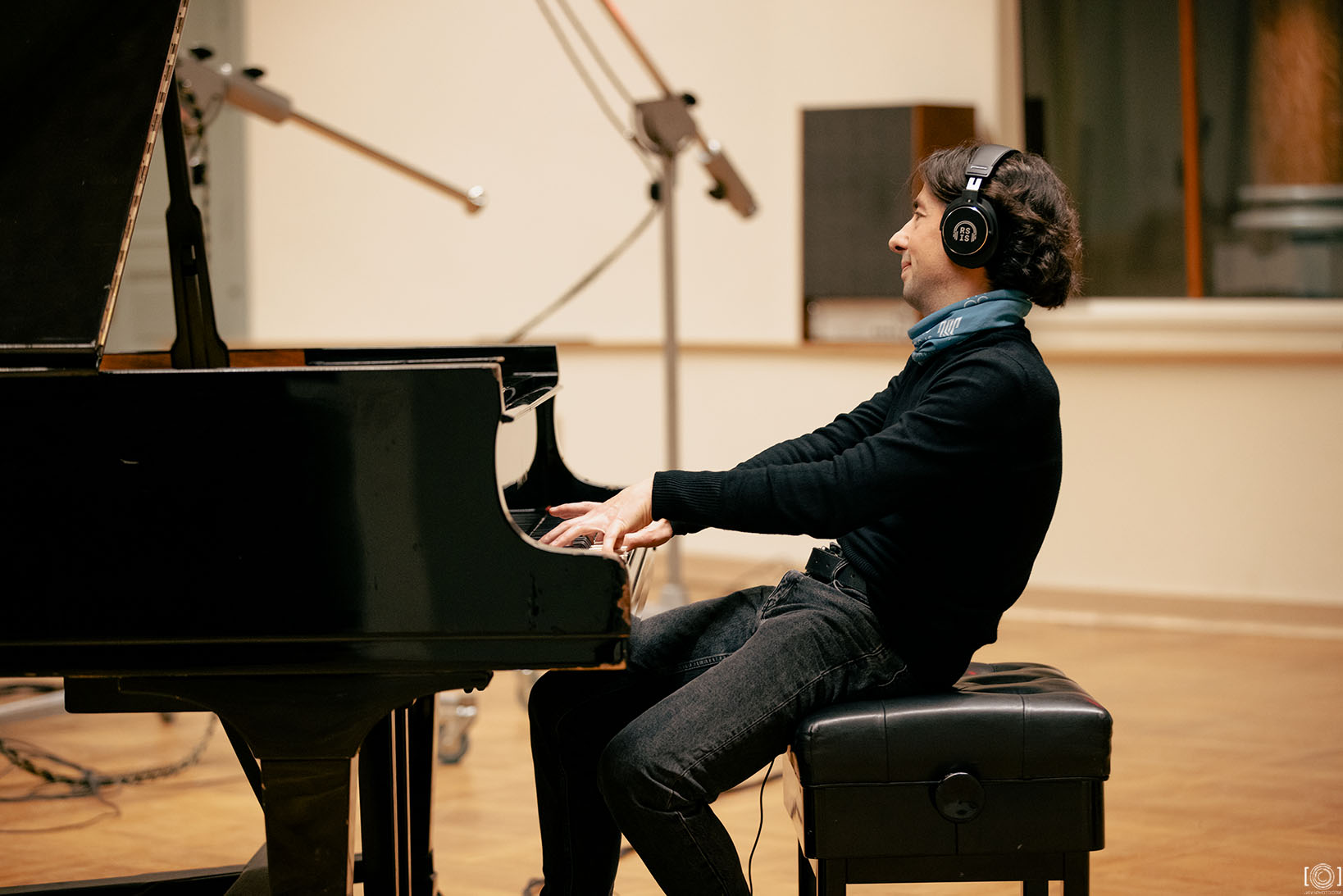
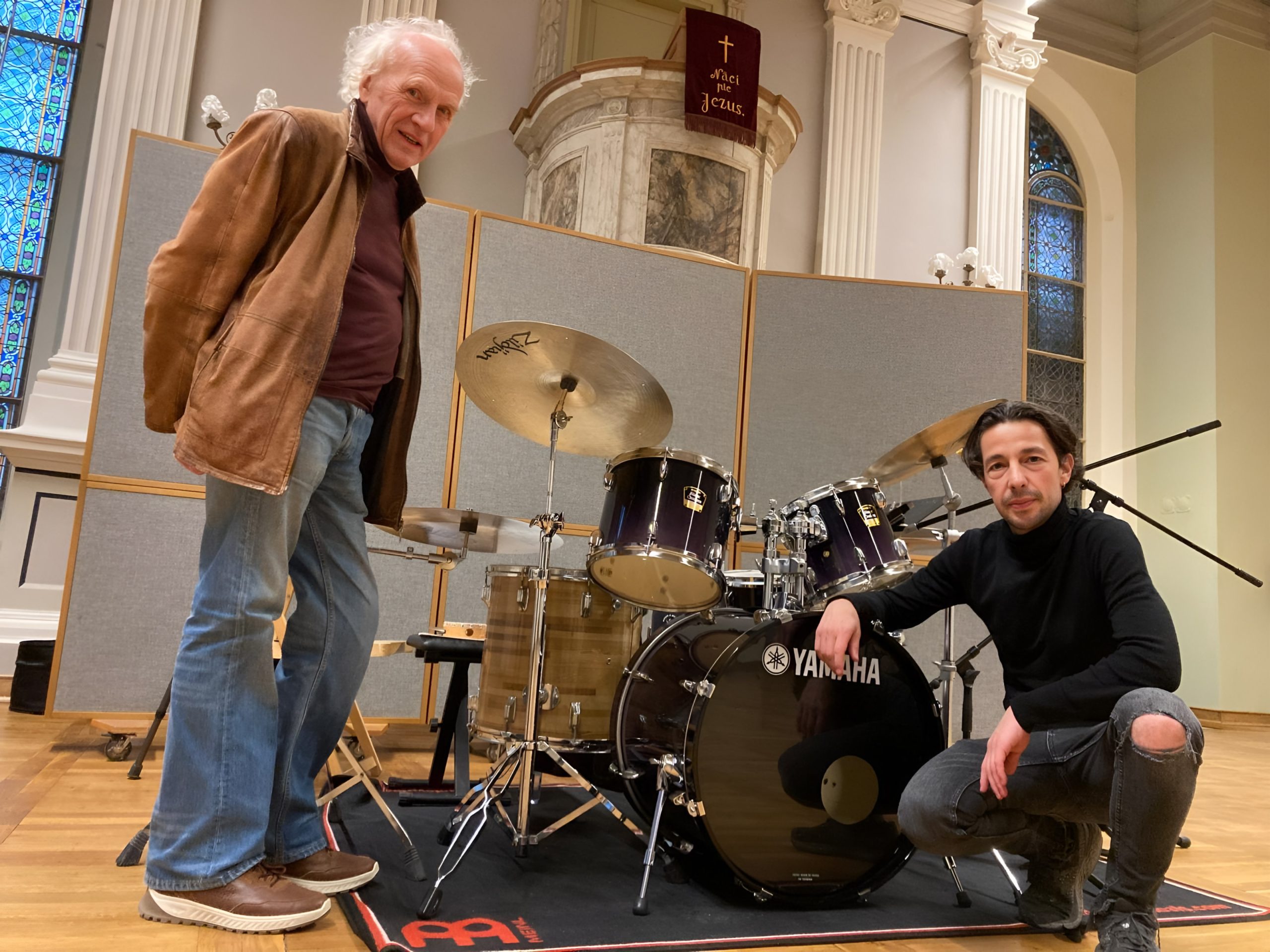
Vladimiras Tarasovas is an inventive percussionist, composer, and visual artist, as well as a laureate of the National Prize for Culture and Arts. He commands a vast array of musical styles, yet his primary passions remain free jazz and improvisational music. Viktoras Paukštelis is often described as an artist of a truly unique nature, presenting audiences with a synthesis of his two great talents: painting and the piano. Following the pianist’s highly successful performance at “Carnegie Hall” in New York, “The New York Concert Review” noted his “first-rate” sense of rhythm, describing his musicianship as sincere, robust, and electrifying.
More about the concert: 06.07 | Paukštelis / Tarasov Return to Paliesius Manor
Source: LRT.LT
– How did you meet and begin collaborating on artistic projects?
Vladimiras Tarasovas: I met Viktoras some 15–20 years ago. I believe it was Saulius Žukas who told me that a very interesting pianist was going to perform. I attended that concert and thoroughly enjoyed it. Viktoras seemingly plays perfectly standard classical repertoire, yet it is evident he has his own distinct style, his own voice. I went up to him afterward, and we talked.
I also remember my good friend Arvydas Šaltenis—who was the rector of the art academy at the time and oversaw Viktoras during his studies there—speaking highly of him as an artist, as a painter. I recently viewed the exhibition Viktoras opened in Antwerp, and I must say—it is superb.
You see, it is like this: talent is either there, or it isn’t. Sometimes people say someone “has a little talent”—there is no such thing. With Viktoras, one can definitively say the talent is there. If a person is a true artist from within, they live through their art—whether they are playing music or painting, they are expressing themselves. What I appreciate is that Viktoras, as a musician, painter, and artist, has no desire to show off, to say: “Here I am, Viktoras Paukštelis, look how good I am.” No, he is part of the art he creates; it is his inner self. He is the sound itself, he resonates—and that is profoundly important.
Viktoras Paukštelis: As Vladimiras described, we met at Art Vilnius. Of course, I had heard of Vladimiras long before then, as he is one of the most serious jazz musicians in Lithuania, one of the very few with a true international career. He has played with musicians of the highest caliber—the GTČ trio (Viačeslavas Ganelinas, Vladimiras Tarasovas, Vladimiras Čekasinas) was among the most modern, democratic, and captivating ensembles in the Soviet Union. I knew that Vladimiras had performed with numerous world-class superstars. So, it was a great honor to meet him, and I am thrilled that we can create together.
– At your concert at Paliesius Manor, Baroque music and contemporary improvisation will converge. How did the idea to blend these genres come about?
Vladimiras Tarasovas: Some months or years after we met, we conceived a joint program. I, of course, knew what Baroque was, and he knew that Baroque music is intimately close to jazz improvisation, as improvisation is inherent there too. I could see that Viktoras is no standard performer who merely sets up the sheet music and plays. He has something to say, he knows how to improvise—and he improvises brilliantly. That is how we created the program “Barokiniai gobelenai”.
Viktoras Paukštelis: Because Vladimiras belongs to the world of improvisation, jazz, and free jazz, whereas I am rooted more in classical music—which is built upon longstanding traditions and rules—our creative visions beautifully complemented one another, and the synthesis occurred entirely naturally. On the other hand, as Vladimiras mentioned, Baroque music is closely akin to improvisation, founded as it is on improvisational, even jazz-like principles. You have certain constant harmonies (such as basso continuo) and bass lines, while above them, there is much improvisation using various melismas, trills, and mordents.
– The manor’s new antique instruments—the organ and the harpsichord—will also be played. How will they complement the music of the program?
Viktoras Paukštelis: The very first thought that comes to mind is that both the organ and the harpsichord were widely used during the Baroque era. True, the Paliesius organ is a Renaissance instrument, from a slightly earlier period, but it will still suit our project perfectly. These instruments possess a unique, distinct resonance, and it will be fascinating to hear how they sound alongside the percussion.
Furthermore, these instruments feel quite natural to me, as both are keyboards, and thus not far removed from the piano. I believe it will be a genuinely captivating concert and an experiment that can only be realized at Paliesius, for only here can one find these specific instruments. You will not be able to hear this anywhere else.
Vladimiras Tarasovas: The idea came from Viktoras, and I think it is an excellent one. Music is like painting; it is the colors of sound. The harpsichord, the historical instruments—it is simply a joy to hear them. What we do with those sonic colors is entirely up to the artist, up to us. I know that Viktoras will execute everything flawlessly. It is wonderful that he conceived the program, and now, the inclusion of these historical instruments.
– What is your creative process like when developing such projects together? Do you follow a strict schedule, or is it rather spontaneous?
Vladimiras Tarasovas: We adhere strictly to the sheet music. If we take a certain theme, the progression of that melodic theme is strict; everything else relies entirely on Viktoras—how he plays, how he improvises, the varying tempos, and so on. We will play; art is a game, as I have said, a game of sound. One can play it alone, but when there is a partner who truly hears you and answers at once, who plays alongside you, it is an absolute pleasure, for both us and the audience. That is how a duet is born, and how music emerges—the music begins to live a life of its own.
Viktoras Paukštelis: I must echo Vladimiras in saying that there is a certain foundational framework where the main points are set out as themes, but elsewhere there is open space—places to improvise and surrender more fully to the mood and the moment. So much depends on listening. I deeply admire working with Vladimiras because there are always those distinct moments when unexpected ideas emerge, compelling you to become new, original yourself. Because of this, performing with Vladimiras is one of my greatest joys.
Just recently, I was listening to an interview with the actor Al Pacino, in which he noted that he reached his highest level of acting mastery only when he began to truly listen to his fellow actors and yield to their energy, in a sense becoming the connective tissue and relinquishing his own ego. Such creative moments with Vladimiras are what intrigue me most, and they emerge precisely through improvisation. This lies not just in varying notes, but in interpretation: in timbres, in tempo, in volume, and so on.
– Both of you not only play music but also work with the visual arts. What might a joint project in this field look like?
Vladimiras Tarasovas: That is something to reflect on. I already mentioned how much I appreciated Viktoras’s work. And I, too, made my own, as I called them, sound games. Well, I haven’t really thought in that direction yet, but you have given me a fine idea (laughs). We will have to think about it; we could certainly create something intriguing.
Viktoras Paukštelis: As Vladimiras says, we probably haven’t thought or spoken about it much. But, of course, it would interest me, as Vladimiras works with both image and sound, and his installations are quite fascinating. If points of intersection were to arise, I would gladly explore how my painting might intertwine with Vladimiras’s expansive way of thinking.
– In your view, what connects music and the visual arts?
Viktoras Paukštelis: I might say both everything and nothing. On one hand, sound and image have nothing in common, yet if you delve deeper, you can uncover a great many shared points—starting from form, structure, balance, rhythm, and many other elements. I believe one could dedicate an entirely separate conversation to this subject. I would single out structural elements most of all, because every work of art must possess certain governing laws. When those laws are robust—whether in music or in painting, and they are frequently shared in parallel—the work is successful.
Vladimiras Tarasovas: You see, when I am on stage—both for me and, I imagine, for Viktoras, since he is a painter, and I created the installation “Garso žaidimai”—the visual aspect actually helps me play. Conversely, when I walk into a museum, a gallery, or when I am working on my own installation, I feel as though I am at a concert. These connections are truly fluid. As I mentioned, art is a game. Everything depends on the artist, on how deftly they are able to guide it.
– What role do you feel art plays in today’s restless world?
Vladimiras Tarasovas: Well, the world right now is a nightmare. There is so much uncertainty—you can no longer tell if there are dictatorships all around, or fascists. It is a catastrophe of sorts, and there is nothing more to say about that. But art remains art. These are times when art cannot wander far from politics, whether one wishes it or not. It need not be an illustration of war, but the reflection itself is present.
To me, the distinction is profoundly clear, because the war will eventually end and cease to be, while art will live on. When we look at what was happening in, say, the 12th century and what is happening now, there is a difference. And yet, we still gaze upon paintings created 600 or 800 years ago, and we derive pleasure from them.
Viktoras Paukštelis: Art is a way to escape; it does harm to no one, and causes no direct violence or pain. It is a refuge where we can leave ourselves behind. However, as Vladimiras says, art cannot be entirely apolitical, because the human being is always a reflection of what is unfolding in the present moment, inevitably shaped by their surroundings. And that influence need not be direct or illustrative—traces of its impact can reveal themselves through intonations, through colors.
– What message would you like to convey to the audience through your music?
Vladimiras Tarasovas: I do not wish to convey any message. Listen and hear. If it pleases you, we will be glad. Music and art are not information; art is a spiritual pleasure.
Viktoras Paukštelis: When Vladimiras and I create together, we lose ourselves. We enter a kind of meditation, stepping into another world entirely. We simply trust each other, we listen to one another, and in doing so, we journey somewhere far beyond words, messages, and everything else. If someone comes, joins in that space, and participates alongside us—that is a joy, because without the listener, none of this would exist. Art only exists because of the observer. If there is no observer, there is no art.