

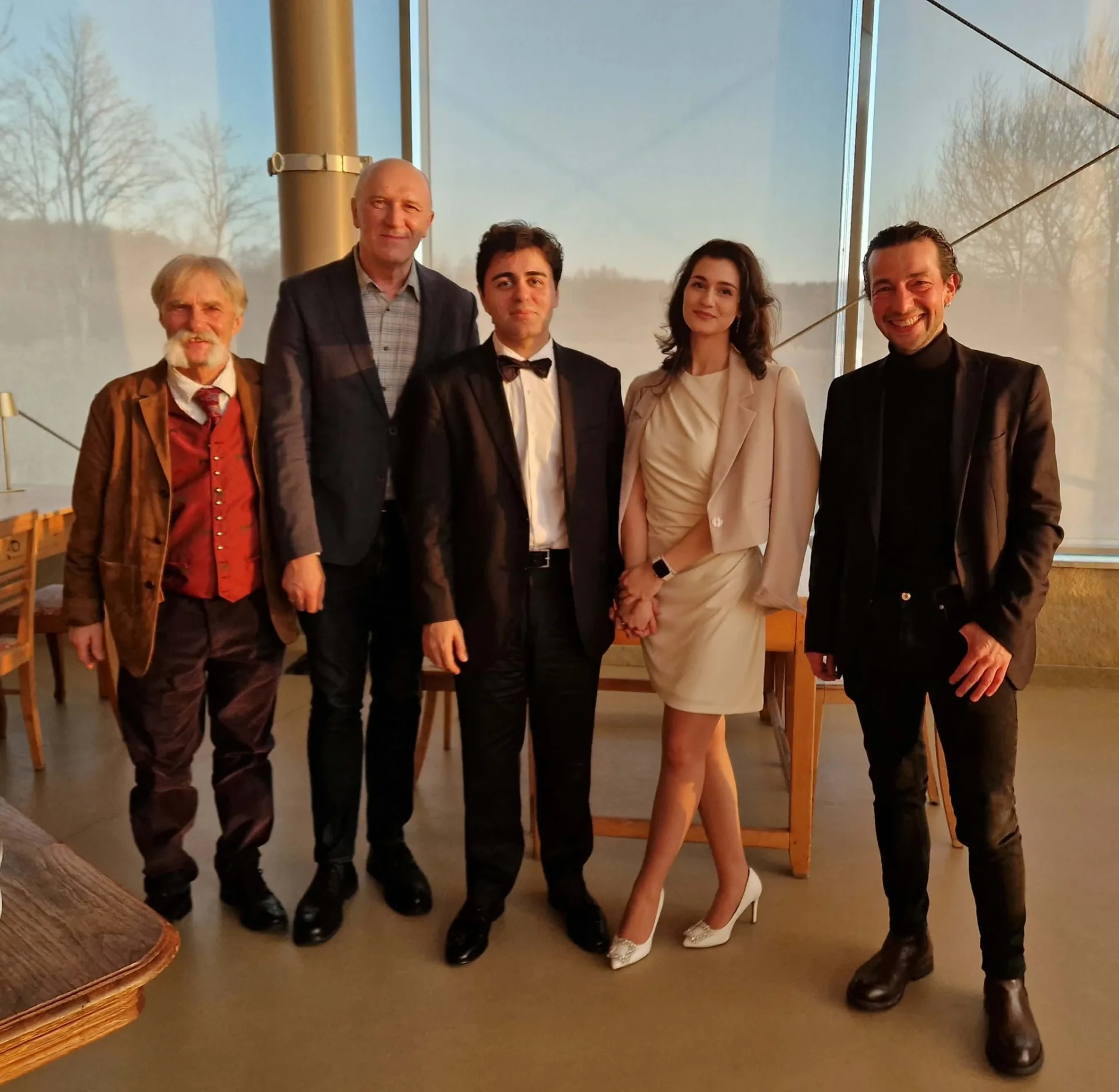
A Sunday afternoon at Paliesius Manor with Frédéric Chopin played by Georgian pianist David Khrikuli. The 24-year-old musical talent competed last year in arguably the world’s most prestigious F. Chopin Piano Competition in Warsaw, where he was a finalist.
This is not the first time that Paliesius Manor, presenting classical music on the highest note, has invited not only established figures of the art world but also freshly shining talents: a couple of years ago, the third-place winner of the same competition (2021), 29-year-old Spaniard Martín García García, performed here; the winner of the 2010 F. Chopin Competition, 40-year-old Yulianna Avdeeva, has also showcased her musical talent here. It seems not so long ago (though nine years have already passed) that French pianist Lucas Debargue (35)—who won fourth place at the 2015 International P. Tchaikovsky Competition, sparking a massive wave of outrage among music critics and experts who declared him the true winner—performed works by the rarely played Polish composer Mieczysław Weinberg alongside violinist Gidon Kremer’s orchestra “Kremerata Baltica,” and later, together in the Paliesius sound recording studio, recorded a CD of another largely forgotten Polish composer, Miłosz Magin…
And David Khrikuli? Born and raised in Tbilisi, this young talent, his family’s only child, began attending piano lessons at the age of seven. To this day, he has never once doubted his calling. Now studying at the Madrid Royal Conservatory of Music and already an F. Chopin Competition finalist, David has over sixty important concerts marked on his creative calendar this year: from Tbilisi to Tokyo. He opened yesterday’s concert in the packed “Pasaga” hall of Paliesius Manor passionately—perhaps barely concealing a flutter of initial, nervous excitement—with the Polonaise in F-sharp minor, Op. 44, and three Mazurkas, Op. 56. Yet, with what exquisitely balanced nuances his performance of the Sonata No. 3 in B minor, Op. 58 rang out! The ultimate peak of subtle romanticism! In the second half, the four Scherzos he played entirely “caught and carried away,” as the saying goes—David Khrikuli seemed to have reached such a profound level of musical concentration that he felt supremely confident, relaxed, and thoroughly reveling in what he enjoys doing best in life.