

Author: Justina Paltanavičiūtė
A summer filled with music is every music lover’s dream. The array of festivals across Lithuania is truly impressive, leaving us wonderfully spoiled for choice. While others might seek a musical frenzy, I look for tranquility and a breath of fresh air. I am delighted to find it in chamber music concerts, where the image of meadow grasses swaying dreamily in the wind becomes an essential conceptual detail of the performance, rather than a merely visual one.
I mention these swaying grasses for a reason—they can be seen through the window just behind the stage in Paliesius Manor’s Horseshoe Hall. Whenever I attend concerts at Paliesius Manor, the sight of these grasses acts as a uniquely performative element, weaving itself symbolically into the evening’s program or into my own quiet reflections as the music plays.
This time, I watched the grasses sway while attending the second „Kremerata Baltica“ festival, held on July 11–12. On the first day of the festival, I attended two concerts. The first was titled „Gyvenimo fragmentai laiškuose“, and the second was untitled as a whole—only its latter half carried the name: „Beieškant Johno Coltrane skambesio“.
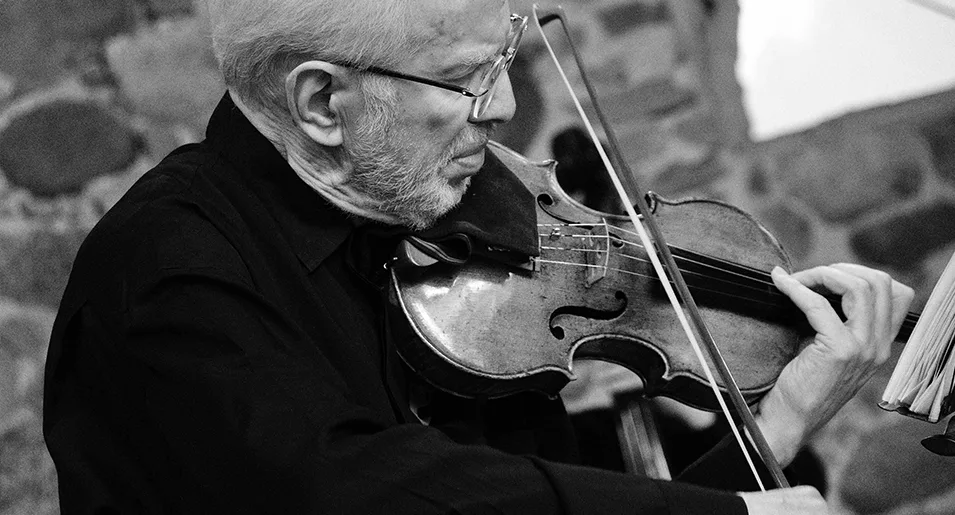
As is well known, the chamber orchestra „Kremerata Baltica“—founded by violinist and artistic director Gidon Kremer—acts as a medium through which the maestro shares his worldly experiences and brings his primarily musical visions to life. Yet this year, one of the festival’s concerts, „Gyvenimo fragmentai laiškuose“, felt distinctly different. It offered not only music but also excerpts from the maestro’s letters—deeply personal fragments of his life, beautifully interwoven with the sounds of the ensemble.
The form of this concert was fascinating, resembling a musical theatrical piece rather than a traditional classical performance. The musical fragments were not announced in advance, allowing the repertoire to unfold as a complete surprise to the listeners. A carousel of music and letters, read by actor Giedrius Arbačiauskas, turned with an intense, rapid grace, revealing pivotal moments of Gidon Kremer’s life. Letters addressed to his father, his beloved, his daughter, his friends, colleagues, and ultimately to himself, stood as a testament to the renowned violinist’s literary talent—or, at the very least, to a deeply sensitive and poetic soul whose life would be unimaginable without music. Certain passages were profoundly moving, bearing witness to the maestro’s difficult life choices.
And what of the music that played between these written fragments? In truth, the specifics hardly mattered, for even the works of familiar composers—Franz Schubert, Johann Sebastian Bach, Mieczysław Weinberg, Leonid Desyatnikov, Shigeru Umebayashi, Ernst Toch, among others—took on an entirely unique character. They were intimately arranged for a small chamber ensemble: three violins (Gidon Kremer, Madara Pētersone, Marija Strapcāne), viola (Jevgēnija Frolova), cello (Magdalena Ceple), double bass (Iurii Gavryliuk), and vibraphone (Andrei Pushkarev). Performed by the members of „Kremerata Baltica“, the music breathed with a single, unified rhythm, working in perfect synchrony to evoke and shape moods of the most delicate hues.
Lightness and nostalgia formed the underlying essence of this carousel of music and words, gently unveiling the breadth of Gidon Kremer’s personal and creative life. As I listened, I found myself picturing a music box from an old French film. Though I assumed this was merely a personal association, it was precisely the sound of a music box that concluded the concert—or, more accurately, the musical play. And while I could have easily lingered longer in the beautiful music performed by the members of „Kremerata Baltica“, it was a rare privilege to view maestro Gidon Kremer so intimately through his letters and melodies. The graceful passages of double bassist Iurii Gavryliuk also left a lasting impression.
Following a brief intermission, the second concert awaited. Truthfully, I had anticipated that taking in two performances in succession might be something of a challenge, but the motif of the meadow grasses swaying carefree in the wind remained with me. The profound sense of lightness endured; only the nostalgia had gently faded away.
The full ensemble of „Kremerata Baltica“ performed J. S. Bach’s renowned „Čakona“ from the Partita for Solo Violin No. 2 in D minor—one of the most demanding works in the violin repertoire, requiring immense technical prowess, emotional depth, and structural insight from the performer. It is not without reason that this piece has been called a monument to the human spirit expressed in art. The „Čakona“ holds special significance in Gidon Kremer’s life and career; audiences have long revered his profoundly philosophical and deeply personal interpretation of the work, which beautifully underscores its fragility. The maestro’s arrangement for chamber orchestra, performed here at Paliesius, retained every ounce of these qualities. „Kremerata Baltica“ showcased their absolute mastery by performing without a conductor, and this particular iteration endowed the „Čakona“ with even greater depth, revealed through the counterpoint distributed across the various string sections, rendering the themes far richer than in the solo original. It felt wonderfully symbolic that the „Čakona“ opened the second concert of the „Kremerata Baltica“ festival. This work, much like the entire performance that preceded it, could truly be called the music of the maestro’s soul.
The evening then progressed to Arvo Pärt’s „Tabula Rasa“ for two violins, prepared piano, and strings. Gidon Kremer, alongside Belgian violinist Pauline van der Rest and Estonian pianist Reinut Tepp, joined „Kremerata Baltica“ on stage. „Tabula rasa“, one of Pärt’s most renowned compositions, can safely be called a cult masterpiece of the classical world—a work that has inspired not only his fellow composers but also performers and listeners to perceive and hear the very phenomenon of music in an entirely new light. Perhaps “hear” is the most essential word here; the interpretation delivered by „Kremerata Baltica“ and these exceptional soloists at Paliesius Manor was utterly captivating, focusing all attention purely on the sound and its resonance in time and space. Gidon Kremer himself has described the piece as a declaration of silence, a manifesto. To me, however, it feels more akin to a tribute to the poetic origins of music. At least, that is how I heard it that evening at Paliesius Manor, lost in the purity of the timbres, the superb acoustics of the hall, the harmony of the orchestra, and, ultimately, the sheer essence of music itself. This deep and evocative rendition of „Tabula rasa“ felt like a natural—yet even more profoundly intense—continuation of Bach’s „Čakona“ that had played moments before. Incidentally, „Tabula rasa“ is another work of extraordinary significance for Gidon Kremer, as it was composed specifically at his request.
Following this deeply philosophical immersion into music, „Kremerata Baltica“ invited the audience to enjoy something delightfully entertaining: chamber orchestra arrangements of works by John Coltrane. The celebrated American saxophonist Joe Lovano stepped onto the stage to perform solo with the ensemble. It was fascinating to listen to the improvisations of several „Kremerata Baltica“ soloists, as well as Gidon Kremer himself. We watched the orchestra members visibly relax and revel in these lighter scores, as Joe Lovano’s free-spirited energy became wonderfully contagious amidst a context usually reserved for serious classical music. Still, the heavily orchestrated jazz left a somewhat softer impression on me than, for instance, the awe-inspiring performances of Bach and Pärt, whose resonance was so masterfully supported by the brilliant acoustics of the Horseshoe Hall.
Indeed, that now-distant summer evening at Paliesius was full of surprises and a distinct sense of lightness—a feeling still brought back to me by the leitmotif of meadow grasses swaying in the wind, an image I have returned to time and again in my writings about concerts at Paliesius Manor. While amid the wealth of surprises I found myself yearning for a bit more pure music, I view this intimate encounter with maestro Gidon Kremer as a deeply significant, historic event, one that unveiled the legendary violinist’s extraordinary bond with his art. This, it seems, is the very essence of the „Kremerata Baltica“ festival at Paliesius Manor—a concept that is already taking root and blossoming into a beautiful tradition. I eagerly await next year’s festival, trusting that it will continue to serve as a glorious celebration of this remarkable figure for many years to come.