

Source: 7MD.LT
Author: Aldona Eleonora Radvilaitė
On July 11–12, the Kremerata Baltica festival gathered music lovers from towns and cities across Lithuania to Paliesius Manor for a robust four-concert event. While some listeners chose to attend one or more performances, the most enduring guests carefully took in all four rather lengthy concerts. Simply arriving at Paliesius Manor inspires a profound sense of joy—a feeling rooted in the blissful silence, the rustling of ancient trees, the tastefully planted floral grounds, the warm, sincere attention the estate’s staff gives to every arrival, and the welcoming presence of the manor’s host, medical professor Dr. Julius Ptašekas, alongside his wife Vitalija. One must also mention the sheer pleasure of savoring the handmade ice cream, delicate pastries, and freshly baked bread.
Before the second Kremerata Baltica festival began this year, the art exhibition “Muzika” from the collection of Samuelis Tacas (Shmuel Tatz) was ceremoniously unveiled. Among twenty-three expressive works depicting musicians by masters of the past (Emmanuel Mané-Katz, Mendel Segal, Grigory Gluckmann, Ossip Zadkine, Jacques Chapiro, Théo Tobiasse, Edna Hibel, Bernard Gussow, Abraham Straski, Vytautas Kasiulis, Neemija Arbit Blatas, Nicolai Cikovsky, Jacques Koslowsky), we also found “Muzikanto portretas” by contemporary Lithuanian painter Mindaugas Skudutis, from the collection of Algimantas Peseckas.
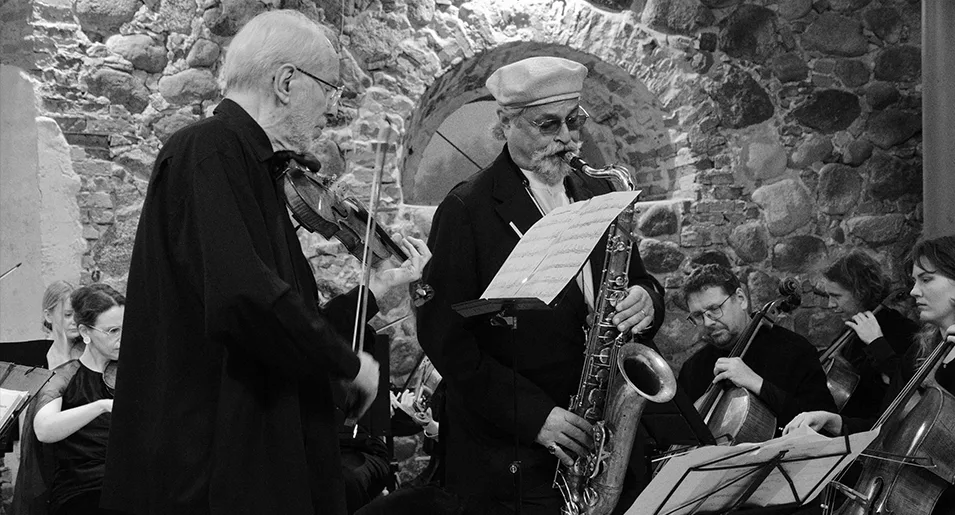
The festival featured the artists of the Kremerata Baltica chamber orchestra alongside guest soloists: the American saxophonist and composer Joe Lovano, renowned Finnish pianist Olli Mustonen, young Belgian violinist Pauline van der Rest, Latvian (born in Kyiv) vibraphonist Andrei Pushkarev, and actor Giedrius Arbačiauskas.
To briefly summarize the impressions of the interpretations heard at the festival, I would note that each of the four concerts opened with music of a calm disposition, culminating in the most tempestuous, resonant opuses. Throughout every performance, the young orchestra members—nurtured by Gidon Kremer’s school of ensemble playing—performed with marvelous subtlety and the highest level of professionalism, responding with absolute precision to the conductor’s every gesture and demand. A profound impression was left by soloists of entirely distinct artistic individualities: the highly subtle, exceptionally tender, mostly hushed, and unhurried musical pourings of Kremer himself, who soloed in many of the works; the massive blocks of sound from pianist Mustonen, who erupted like a volcano with elemental, innate force in the final concert; the distinct interpretations of the very young Pauline van der Rest, who has already successfully competed in various national and international competitions, playing the violin with refinement, subtlety, and mastery; and the bright, striking sonorities of the percussionist, Kremerata Baltica soloist, and arranger Pushkarev.
The festival commenced on July 11 with a rather unusual program titled “Gyvenimo fragmentai laiškuose”, performed by Gidon Kremer, reader Giedrius Arbačiauskas, violinists Madara Pētersone and Marija Strapcāne, violist Jevgēnija Frolova, cellist Magdalena Ceple, double bassist Iurii Gavryliuk, and vibraphonist Andrei Pushkarev.
With emotional, undulating dynamics, the actor Arbačiauskas read letters conveying childhood impressions and life right up to 2025, while varied, gently treated, and mostly quiet music drifted softly between the words. Into this long performance (lasting about an hour and a half), an episode of noisy shouts and calls from the performers intruded as a sharp contrast.
In a later concert, listeners were delighted by the bright, joyful musicianship of American multi-instrumentalist and saxophonist Joe Lovano, playing alongside the orchestra, Kremer, and Pushkarev in the composition “Beieškant Johno Coltrane’o skambesio”. At the beginning of this late concert, Kremer’s version of Johann Sebastian Bach’s renowned “Chaconne” for strings was heard. The arrangement raised slight doubts, as this music ultimately sounds more perfect when conveyed by a solo instrument; in this instance, only the climaxes and tutti episodes sounded truly convincing.
Arvo Pärt’s “Tabula Rasa” was compellingly performed by Kremer, the talented van der Rest, Estonian pianist Reinut Tepp, and the orchestra. The energetic first movement of this work gave way to an exceptionally long, chillingly thoughtful, subtle, and hushed second movement—akin to magical cosmic music—that demanded extraordinary endurance and concentration.
On the afternoon of July 12, the festival’s third concert began with calm, gentle sounds. Thus sounded the cycle of pieces “Eine (andere) Winterreise – pagal Franzą Schubertą”. The composition was performed sensitively and pleasantly by the festival’s inspirer, Kremer, with colors added by percussionist Pushkarev and Kremerata Baltica, who subsequently delivered an uplifting, highly masterful treatment of Mieczysław Weinberg’s Aria, op. 9, for strings.
The focal point of the fourth and final festival concert was the appearance of pianist, conductor, and composer Olli Mustonen. He has earned a Grammy Award for Best Chamber Music Performance. Mustonen played and conducted Bach’s Keyboard Concerto in D minor (BWV 1052) for the Kremerata Baltica orchestra while seated with his back to the audience. It felt as though a mighty volcano had erupted, its lava bubbling tempestuously and glowing as it surged forward with astonishing force. In Mozart’s Piano Concerto in E-flat major (K 449), this volcano hurled bright sparks that would flash brilliantly and then suddenly fade away…
During the concert’s intermission, listeners actively discussed the pianist’s interpretations. Some were moved by such elemental suggestion, reasoning that Bach was a powerful figure whose art flourishes to this day, and that Mozart was, after all, a young, mischievous genius, making such a performance both special and stirring. Others felt that the performance style of these works should more closely match their historical era.
The program’s greatest contrast came after the intermission, with Pauline van der Rest and the orchestra playing Weinberg’s Concertino, op. 42, in a highly subtle, refined, and beautiful manner. Because the printed program had indicated that Kremer would be the soloist, the maestro played a brief piece with pianist Mustonen before this opus.
The festival came to a roaring close with Mustonen’s own String Quartet No. 1, performed by Kremerata Baltica and conducted by the composer himself. The interesting and distinctive minimalist work stunned the audience with the conductor’s elemental treatment. To the author of these lines, an image arose: as if a wide, tall wooden fence were being torn apart by a massive tornado—now lifting it skyward, now slamming it back into the earth. The composition also held its calmer moments. Mustonen exerted tremendous effort. For instance, while playing and conducting the aforementioned concertos, he would throw his left arm up in an unbelievably sudden gesture, thereby inspiring the orchestra members. When conducting his own piece, he was so restless (we witnessed squats, leaps, and the “twisting” of his body) that the body language of our known conductors at the podium seems truly restrained by comparison. It is interesting to note that Mustonen guided his work in long lines which, despite being “tossed about,” remained unbroken.
Kremer also appeared on stage to bid the audience farewell. We will wait to see what intriguing offerings this Master of music and his companions will bring to us next year at Paliesius Manor.