

Source: 7MD.LT
Author: Justina Paltanavičiūtė
Though the journey from Vilnius to Paliesius Manor is somewhat long, it is a road always worth taking. This magical place beckons with the rare chance to immerse oneself entirely in the music, leaving behind any “extra-musical” noise—to simply listen and linger in the here and now without distraction. For me personally, the harmony between the shifting seasonal landscape and the concert programs evokes entirely unique, ever-changing sensations.
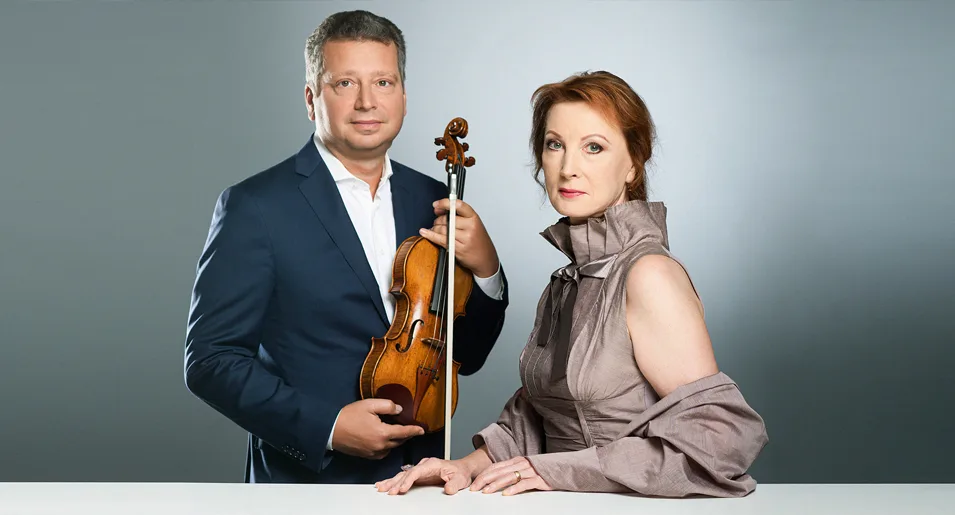
On a warm late afternoon this past August 24—already tinged with the nostalgic breath of autumn—pianist Mūza Rubackytė (Lithuania, France, Switzerland) and violinist Dmitrijus Makhtinas (Netherlands) graced Paliesius Manor. Entitled “La belle époque”, the concert brought to life works for violin and piano by Leopold Godowsky, Johannes Brahms, and Karol Szymanowski. The evening also served as the debut of the artists’ new album, “Valses impressions”. This recording gathers violin and piano works by Godowsky and Szymanowski—pieces that still echo through concert halls far less often than the composers’ ventures into other genres.
Historians regard la belle époque (circa 1871–1914) as the pinnacle of European civilization’s flourishing to date. The music born of those years is captivating and still not entirely discovered—drifting away from the grand ideals of Romanticism, yet not quite steeped in the conflicted dissonance of Modernism.
The two-part concert featured Godowsky’s waltz-poems, miniatures from the cycles “Twelve Impressions”, “Triakontameron”, and “Four Poems”, which Rubackytė and Makhtinas wove together into two distinct, self-arranged cycles; Brahms’s Sonata for Violin and Piano No. 1 in G major, Op. 78, and Szymanowski’s “Three Paganini Caprices”, Op. 40. Fritz Kreisler’s “Miniature Viennese March” was played as an encore.
Three of Godowsky’s miniatures—Larghetto lamentoso (from the “Twelve Impressions” cycle), “Valse macabre” (from the same), and “Nocturnal Tangier” (from “Triakontameron”)—were bound into a cycle with great dramaturgical success. Opening lyrically, at a larghetto tempo as the title suggests, and steadily building dramatic tension, the artists unveiled the rich timbral colors of their instruments within this “cycle”, carrying on a mature, well-considered dialogue in both tone and structure. Of the entire concert program, this segment was the most deeply pleasing to hear, as it strayed furthest from overt emotionality, drama, and figurativeness. The beautifully balanced relationship between the violin and the piano, alongside the calm, steady pulse of the music, breathed tranquility—quieting the mind, inviting relaxation, and simply letting one savor the music.
Brahms’s Sonata for Violin and Piano in G major is one of the composer’s most lyrical works. Rubackytė and Makhtinas’s rendition swayed like a carousel—just as it seemed about to rise toward its sweeping climaxes, the tension would ease, returning to a state of quiet concentration, preventing the melodies from dominating or the listener from feeling overly sentimental. This interpretation drew the piece closer to the soundscapes of Godowsky and Szymanowski, weaving it seamlessly into the broader sonic tapestry of the concert program.
A slightly more intense musical experience awaited in the second half. It began with another gathering of Godowsky’s miniatures: “Avowal”, Waltz-Poems No. 1 and No. 2, “Élégie”, “Viennese”, “Waltz”, and “Tyrolean” from the “Twelve Impressions” cycle, once again offered as an improvised cycle arranged by the performers themselves. This time, both the music itself and its interpretation were far more tempestuous than the “cycle” of the first half—the compositions echoing like a succession of ever-intensifying, increasingly dissonant Viennese waltzes. While the true, authentic Viennese waltz sweeps you into a light, untroubled bravura, these Godowsky miniatures kept the mind taut; as one listened, there was a yearning to draw near the opulent sound of a Vienna ball, yet the mind continually anchored itself in a far more intellectually demanding musical landscape.
At the close of the concert, the duo served a measure of athletic virtuosity—Szymanowski’s “Three Paganini Caprices”. Though both Rubackytė and Makhtinas showcased flawless technique and breathtaking nuances in the musical colors of the violin and piano, it occasionally felt that works of such towering complexity leave little room for the music itself, at least within the listener’s consciousness. While these three caprices undeniably left a profound impression on the audience, they stirred in me a lingering nostalgia for the earlier program. During the Godowsky miniatures or the Brahms sonata, gazing out the window (just behind the stage) at the autumnal fields swaying in the wind, I had basked in the pure autonomy of the music. I thought neither of worldly matters, nor of the histories behind the compositions, nor of any other connotations of this intangible art.
A great triumph of the concert was the deeply considered dramaturgy of the program, which crafted the feeling of one unbroken, seamless event. All the pieces merged into a sweeping, ever-intensifying form; as you listened, there was no need to decipher what separate story each individual work was trying to tell. Indeed, the overarching spirit of the program was rooted purely in musical essence—in the exquisite harmony between violin and piano, the performers breathing as one, moving forward together in absolute lockstep.
Natural and mature—these two words most aptly capture the heart of the concert experience. One is left simply longing for more of these crystalline, unhurried musical afternoons. So, until next time, Paliesius!