
Source: 7MD.LT
Author: Raminta Jurėnaitė
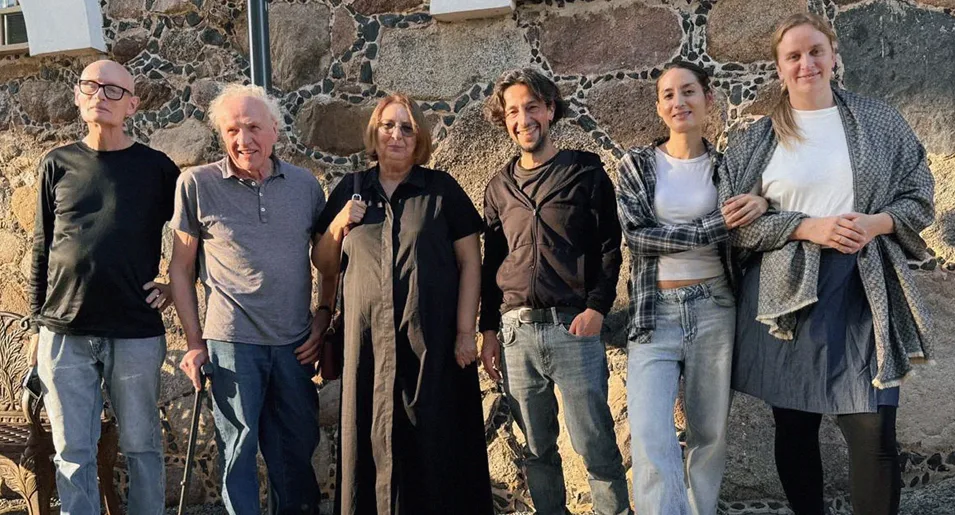
This August, artists of different generations from Vilnius, Paris, and Tel Aviv gathered for a creative residency at Paliesius Manor. For a week, embraced by a welcoming environment, they painted, drew, made music, and spent their evenings in conversation. The creators invited local residents and other guests of the Manor to viewings of their work, lectures, and art classes. The residency culminated in a guest artist exhibition and concert.
During their residency at Paliesius, Vladimir Tarasov (percussion) and Viktoras Paukštelis (piano) prepared an impressive concert uniting their distinct experiences in jazz and classical music performance. The large audience that gathered for this concert was also introduced to the visual art created by both musicians.
In the Paliesius Manor cellar, Vladimir Tarasov exhibited the video installation “The Sixties (Sketch).” As with this artist’s other installations, its strength lies in a successful blend of visual and auditory expressiveness. V. Tarasov conveys the intoxicating freedom and creative energy of the 1960s through concert recordings of the era’s most popular musicians, playing against the backdrop of a blooming poppy field. This imagery commands attention and awakens a wealth of associations.
The other four residency participants presented a joint exhibition in the Manor’s “Pasaga” hall, offering viewers a wonderful opportunity to see the varied artistic strategies embraced by contemporary painters today.
Leo Ray, a Lithuanian emigrant living and working in Tel Aviv, creates a playful and light fantasy world, drawing and painting in the primitivist manner of children’s drawings. On sheets of white paper, cheerful and sorrowful little figures, animals, and birds set off on adventures. All these beings are drawn as pictographic figures formed from lines, circles, and triangles. They run, fly, or pause for a moment, experiencing ever-new adventures. In his work, L. Ray intertwines a penchant for storytelling with the creation of laconic signs, and decorativeness with expression. To set the mood, the black contour line and empty white background are just as vital here as the vivid hues of blue, red, and yellow.
The opposite pole to Leo Ray’s spontaneous subconscious play is the painting of the other three exhibition participants, which is rooted in an analysis of nature and art history. Mykolė Ganusauskaitė and Ségolène Kan focus on a contemporary interpretation of the traditional landscape genre. Having studied together at the National School of Fine Arts in Paris, they have preserved their friendship and today collaborate with the same art gallery in this metropolis.
In recent years, Ségolène Kan has sought inspiration in distant journeys. She paints the motif of mountain ranges in an endless steppe as a longed-for metaphor of nature untouched by human activity. On massive sheets of paper, with sweeping brushstrokes and thin layers of paint, the artist shapes the silhouettes of mountains, clouds, and sparse vegetation. The landscape lessons of William Turner, as well as Gustave Courbet, are essential to the artist, though they reveal themselves only gradually. In the studio, she bestows an epic character upon an intimate nature etude, all while preserving the impression of pulsating light.
At Paliesius Manor, Mykolė Ganusauskaitė’s attention was drawn to the picturesque banks of the Kančiogala River. She meticulously studied the unique topography and vegetation of this motif, ultimately perceiving a universal ornamentation within nature. On her canvases, the artist reconstructs a specific landscape with absolute precision. The trees, bushes, and curves of the riverbanks form the spatial framework of the painting’s composition, where fine, ornamental details of reeds, leaves, and grass stalks seamlessly merge. Mykolė uniquely harmonizes analytical constructiveness with the expression of nature’s constant transformation. Pulsating combinations of vibrant green, yellow, orange, and light blue radiate the heat of summer. In Mykolė’s paintings, one can discern the inspiration of David Hockney’s landscapes, alongside entirely independent, distinctive avenues of exploration.
In his work, Viktoras Paukštelis frequently appropriates the creations of the old masters. The eternal, existential themes of these works are deeply important to the artist. At the same time, as he paints, he does not merely repeat; he varies and transforms. This time, he painted after a work by the Baroque painter Carlo Dolci, depicting Mary Magdalene. V. Paukštelis was captivated by the theme of ecstasy, the pulsating, dramatic tone of the piece. By forsaking color, crossing out, and fragmenting, he reveals how alien such an emotional outburst feels to our own era. Caught in a whirlwind of contradictory emotions himself, the artist compels the viewer to doubt and feel a sense of unease.
The exhibition featuring these five distinct artistic individualities will also be shown this autumn at the “Nalšia” Museum in Švenčionys and the Zarasai Region Museum.
The art residency is partially funded by the Lithuanian Council for Culture

Project organizer – Paliesius Manor Association