

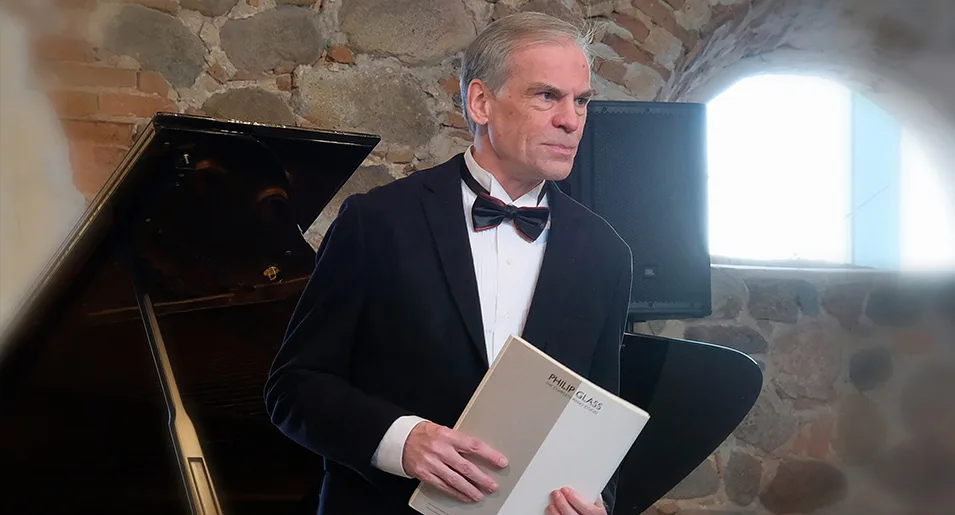
Jurgis Karnavičius is one of the most distinguished Lithuanian pianists of the older generation, a professor at the Lithuanian Academy of Music and Theatre, who headed the Piano Department from 2011 to 2020.
In the 1980s, he was one of the first Lithuanian pianists to win awards at prestigious international piano competitions (R. Schumann in Zwickau, L. van Beethoven in Vienna, and others).
J. Karnavičius prepares impressive monographic programs—for example, between 2022 and 2024, he presented Paliesius Manor concertgoers with the grandiose cycle of Philip Glass’s 20 etudes for piano. On November 15, the performer returns to the manor’s “Pasaga” concert hall to perform all the piano nocturnes of the French romantic Gabriel Fauré (1845–1924). This will be the first concert of its kind in Lithuania.
In anticipation of the concert, J. Karnavičius is interviewed by Eglė Ingelevičiūtė-Jablonskienė.
More about the concert: 11.15 | Gabriel Fauré. Noktiurnai
Source: LRT.LT
– You were born into a family of musicians. What was your childhood like? Did you want to be a pianist from an early age?
I am probably not a very typical musician, as I had a true, wonderful childhood—there was time for walks in nature, for games, and simply for quiet moments with my parents and grandmother. I was a homebody; I didn’t attend any kindergartens, and I only began playing the piano at the age of seven, when I entered the M. K. Čiurlionis School of Art. I was never forced to practice six to eight hours a day. During my primary school years, playing football in the courtyard with friends was a much more fun and pleasant activity than playing the piano. So the desire to be a pianist certainly wasn’t clearly expressed until finally, probably in the tenth grade, following a particularly successful exam, I felt very vividly that what I do at the piano is my life, and I want to do it. After that, I never once had to doubt the choice.
 – How has your relationship with the piano changed over the years?
The piano is my greatest friend; conversing with it brings immense pleasure, as it opens the path to Music. And Music, you must agree, has a truly profound impact on a sensitive soul—it makes one forget the everyday, calming and comforting when needed, or inspiring new quests and discoveries. So my relationship with the piano has essentially never changed, only grown deeper—the greater your mastery of the instrument, the more wonderfully and richly it answers you. I have two magnificent pianos at home, a Steinway and a Bechstein, which my Father acquired in his time. Sometimes I think I would agree to lose anything, just not them.
– Your concerts are not very frequent. What does your preparation process look like?
I have never been a pianist who plays 100 concerts a year, and I am very glad for that—a concert is a special occasion for me; I cherish it and prepare accordingly. I believe it is best when the process of preparing a piece unfolds naturally, rather than at a forced, accelerated pace. It is much like food: a natural, high-quality, freshly prepared meal will certainly taste different than a semi-finished product warmed in a microwave. As the concert approaches, I sense what kind of form I am in, and then I know what I must do and how I must do it when I sit down at the instrument that day. I boldly allow myself not to play at all for perhaps two or three days in a row; during that time, my hearing rests, my thoughts realign, and I notice new, unexpected aspects in pieces that seemed already perfectly familiar. In truth, I have the invaluable luxury of playing what I want, when I want, and where I want—this is genuine happiness for a performer.
– Paliesius Manor is already familiar to you—you performed Philip Glass’s piano etudes here. Is the concert space important to you? What impact, in your view, does the performance venue have on the music?
I not only played Philip Glass’s etudes in concerts here, but later recorded them as well; I cannot imagine better conditions for such work. I mean not merely the material conditions—the hall, the piano—but above all, that special aura of Paliesius Manor nurtured by its hosts. The concert space is truly important to me; even the same program sounds slightly different in different spaces—the musical sounds seem to weave an emotional connection with their surroundings. In this way, every concert becomes a unique experience.
– This time you will perform Gabriel Fauré’s nocturnes. What is your personal connection to these pieces?
My Father studied in Paris for four years during the interwar period; this span of time left a truly profound mark on his personality. My Father spoke fluent French, was fundamentally a man of Western worldview, an intellectual, an erudite, and that spirit was always alive in our family. Perhaps that is why I have always felt a special connection to French music, and that connection has certainly been reflected many times in my concert programs.
As for Gabriel Fauré, he perhaps most vividly embodies the very essence of French art—aristocracy, elegance, extraordinary compositional mastery… His music is a world of extraordinary richness, though, in truth, not everyone will easily notice those riches… This is not music for the masses; its intimacy likely accounts for Fauré’s relatively modest popularity and renown. Yet those who have even once felt the charm of this music will, I believe, remain its faithful admirers for all time.
– You are also a pedagogue. What do you strive to teach young pianists?
I strive to teach them to be themselves, to be first and foremost musicians and artists, rather than merely pianists. It is deeply interesting to observe myself as a pedagogue and to witness a constant evolution. With time, certain attitudes and priorities shift—after all, we do not live in a stagnant world. Knowledge is important, but experience is even more so; I feel happy being able to share it with my students.
– What inspires you the most? In life, in music, in art in general?
I draw my greatest inspiration from nature and travel—new impressions are simply essential for an artist, and the emotions one experiences often serve as the finest key to one piece of music or another. Also architecture, cinema, literature—all of this is absolutely vital if one wishes to be a true musician.