

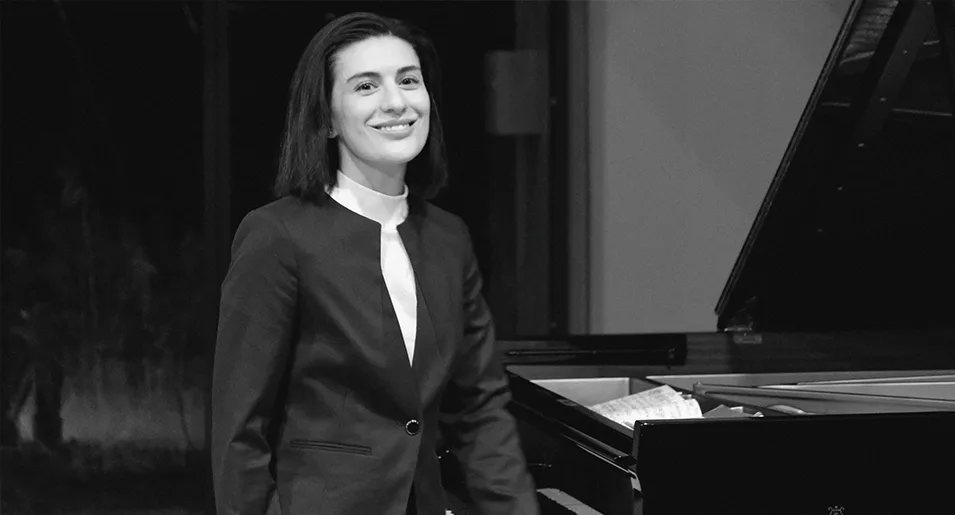
Source: 7MD.LT
Author: Daiva Tamošaitytė
The elegant spaces of Paliesius Manor welcome audiences who travel from near and far to listen to music. A steady circle of admirers has already taken shape, undeterred by dark winter evenings or slippery roads. They are greeted by the impressive stone walls of the former stables resting beneath a glass roof, bread and pastries baked from local farmers’ flour to accompany their coffee, and a cozy, inviting glow. In the “Pasaga” concert hall, magnificent “Stainway&Sons” instruments and exceptionally fine acoustics await. It was precisely this acoustic brilliance and the intimacy of the hall—fostering a close, mutual bond between performer and listener—that inspired the well-deserved compliments and near-perfect trajectories of sound from Mariam Batsashvili, the Georgian-born, Germany-based pianist who performed here for the first time on December 14.
Mariam Batsashvili’s path to acclaim began in Weimar, while studying at the Ferenc Liszt University of Music under Professor Grigory Gruzman. In 2011, she won first place at the 3rd International Liszt Competition for Young Pianists in Weimar, and in 2014, at the 10th International Liszt Competition in Utrecht. In 2015, Batsashvili received the prestigious Arturo Benedetti Michelangeli Award. The 31-year-old pianist is a BBC New Generation Artist and an official YAMAHA Artist who has released two CDs (recording exclusively with the “Warner Classics Label”). She tours extensively across the globe and leads online masterclasses.
These lessons have already captivated nearly 75,000 students who remotely follow her weekly one-to-three-minute videos on Mariam’s personal YouTube channel, in a series titled “At a closer look…”. Here, the pianist shares personal insights into interpreting the more complex episodes of musical works, unveiling new meanings (for instance, the Schubert-Liszt Serenade (Ständchen) can be played “generally,” or it can be infused with the specific emotion of someone falling in love). As Mariam told the author of this article, she received her foundation and everything of true importance from her first teacher, Natalia Natsvlishvili. Among all the gifts bestowed upon a pupil who is utterly devoted to their guru—for successful piano lessons are a lifelong school and an “exchange of souls”—she was clearly instilled with a love for playing and a pedagogical flair. Thus, every performance becomes an almost imperceptible address to the listener, like that of a Teacher delicately awakening their inner worlds.
Mariam Batsashvili was born for the piano. This is the calling card I would assign to her artistry. Fragile and modest, yet willful and deeply focused; gentle and warmly smiling, yet at times an absolute volcano of energy. Her impeccably correct and composed posture at the instrument allows her to engage her entire body in maximum contact with the keyboard, harnessing every physical possibility of this connection. What emerges is absolute mastery—an effortless grace in executing the most demanding passages with clean precision, and a profound freedom in her music-making.
On the evening of December 14 at Paliesius, Batsashvili began with Wolfgang Amadeus Mozart’s Sonata No. 18 in D major (KV 576). Here, she enchanted the room with her precise, intricate technique (the third movement being particularly rewarding in this regard) and beautifully chosen tempos. In her hands, Mozart—where everything is clear and transparent—sounded resonant, effortless, and wonderfully stylish. Next, we heard Sigismond Thalberg’s “Grand caprise sur des motifs de ‘La Sonnambula’, op. 46”. With this piece, the pianist revealed a fairy-tale agility and a captivating grip of the keys: her scales were like a necklace strung with distinctly heard, brilliantly shining rounded beads. The majestic musical palace of the caprice was sumptuously adorned with chromatic scales and garlands of chords and octaves.
Of the two Hungarian Rhapsodies by Ferenc Liszt, the first (No. 14 S.244/14) in F minor showcased an exemplary pianism. The virtuoso effortlessly gathers the repetitions, the tremolos, and all the little “bells” of the Hungarian dance motifs into her hands, making it seem as though her hands are dancing on their own! With precise, calculated movements, her entire technical arsenal is brought together so seamlessly that playing appears beautifully simple. She demonstrated this magic of mastery to devastating effect in the Hungarian Rhapsody No. 2 as well. The second half, with all its famous acrobatics, was simply breathtaking in its subtlety. There was no trace of laborious “work,” no heavy, imposing weight—only the phenomenal capabilities of her small hands and a deeply sensitive ear, elevating the sparkling musical material to an entirely different realm of artistic finesse. Another fitting epithet for this pianist: a sorceress drawing from a wellspring of gleaming, scintillating sounds.
It is no coincidence that the program also featured Franz Schubert, a composer deeply admired by Liszt. The four Impromptus from Op. 42 never once felt drawn out, for the music flowed with an exquisite naturalness, breathing lively spirit into the thread of thought and elegantly conveying the pearls of Schubert’s lyricism and characteristic moments. Her optimal use of the pedal is also worth noting—nothing ever blurred, leaving the texture crystalline and clearly heard.
In summary, it must be said that encountering this renowned Georgian virtuoso awakened a deep desire to follow her journey and draw from her well of experience. To me, Mariam Batsashvili’s approach feels profoundly close, rooted in professional honesty, feminine intimacy, and a beautiful generosity in sharing the beauty of music—just as the most secret mysteries of the musical arts are shared in the piano classes of the greatest luminaries.