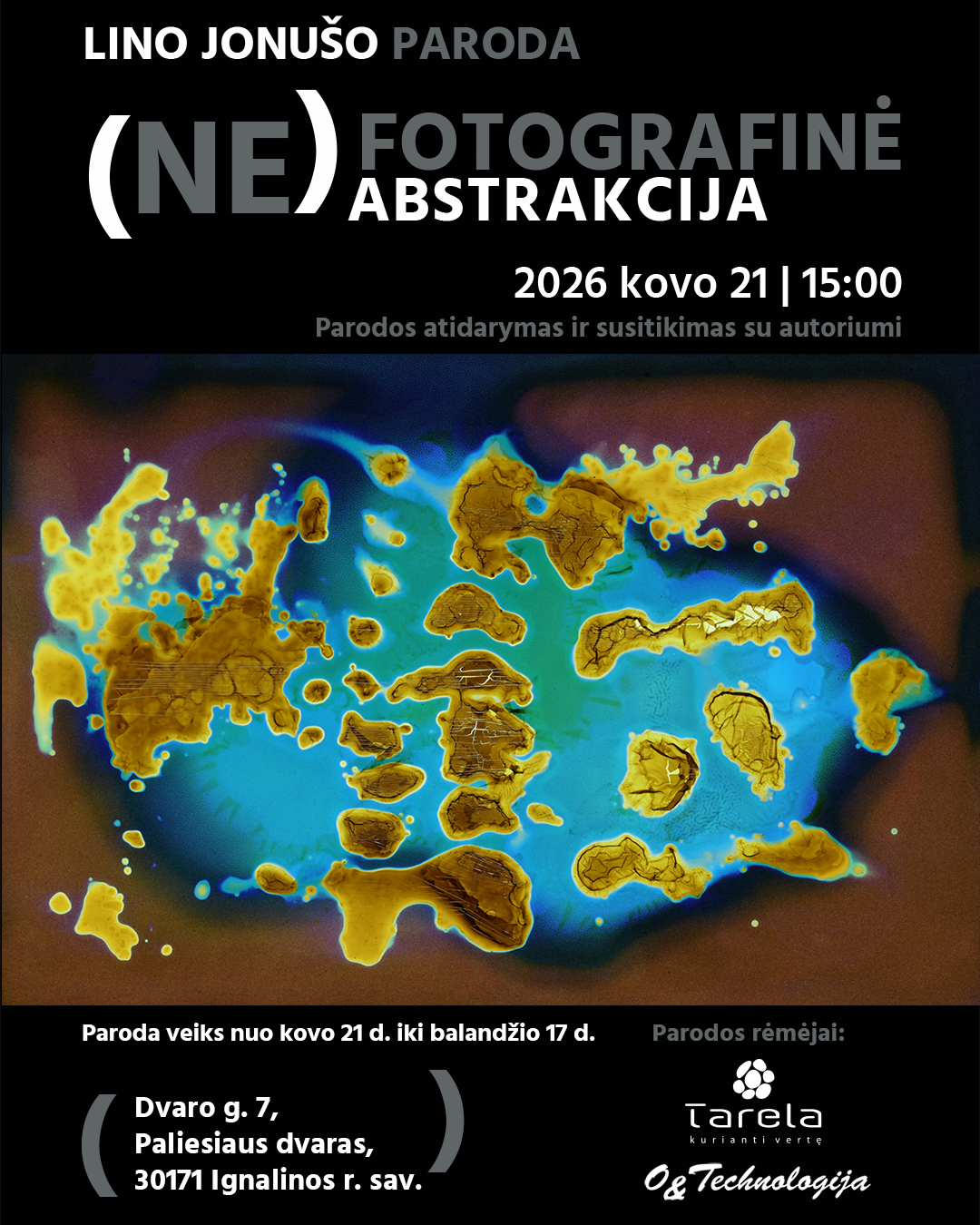
Doctor of Humanities, Art Historian Vytautas Tumėnas
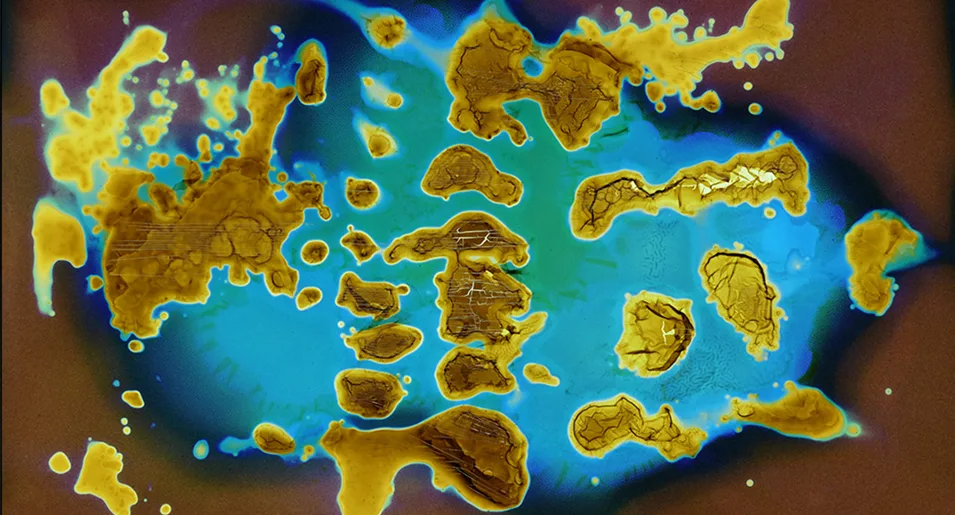
The exhibition features 16 artworks by photographer Linas Jonušas—a completely unexpected phenomenon in visual art that fundamentally and experimentally merges painting, graphics, and photography. The creation of these works begins with flawed, low-quality, blackened frames of slide film. Upon such a frame, the artist paints his visions in a singular manner. Like a master jeweler, carefully and meticulously dripping specific chemical liquids (salt solutions), he paints distinct threads and spots that unpredictably and willfully flow, spread, and blend like watercolor. When the chemical reactions subside, the finished slide image is transferred onto large-format aluminum composite sheets via digital photographic printing at a printing house. It is in this way—as a result of these complex, unusual, and, I would say, “alchemical” processes—that Linas Jonušas’s associative, expressively emotional abstract artworks are born, works the artist has been creating for an entire decade.
In the artworks of Linas Jonušas, I am amazed by the newly unfolding horizons of coloristic possibilities, as the colors of these aluminum-based pieces are extremely sensitive to light—they shift significantly depending on the angle of illumination (especially sunlight). And certain colors, possessing a pearlescent depth, even shimmer from within under specific conditions. Linas’s works burst into the art world with a completely extraordinary, uniquely distinct, mysterious presence, full of colorful depth, and above all, a harmonious coloring that sensitively bridges muted and vibrant colors with the reflections shaped by the artworks’ aluminum surface.
The imagery in Linas Jonušas’s artworks evokes formations on the surfaces of water, in clouds, or within various other liquids; at the same time, they recall the microbiological world we might see through a magnifying glass, or mirages of flora and fauna trembling through a veil of fog or smoke. They might evoke the astronomical forms of cosmic bodies and nebulae, or galaxies, or simply embody the creator’s feelings—becoming, as it were, a painterly map expressing his innermost experiences. For some, this may simply signify an intuitive, chance-driven, impulsive painting process; for others, it is an allusion to the evolution of the cosmos, the expansion of flora, the aquatic life of algae, or a million-year-old world captured in translucent amber inclusions. Still others might perceive the impression of a mystical, subconscious spatial realm, guided by barely recognizable associations of blossoms, elk, wolves, or entire forces of nature.
Searching for equivalents in Lithuanian art, memories first arise of the experimental glass painting by stained-glass artist Br. Grušas, characterized by a vibrantly colored, biomorphic, and emotional abstractionism. Yet the imagery in Linas Jonušas’s artworks differs not only in its technology; it carries a far stronger associative power, narrower amplitudes, and a more stylish coloring. Alongside his photographic creations, Linas Jonušas’s artworks surge into our art world with a remarkably fresh, powerful, and utterly innovative, experimental expression. They significantly expand the traditional concepts of painting, graphics, and photography. Through the mystery of their creative process and the chance or intuitive determinism of flowing, spilling paints, they also echo, in a sense, the unpredictability of fluid watercolor washes. Thus, on the one hand, Linas’s creations possess a highly rational technological ingenuity, and on the other—a quiver of spontaneous intuition, unexpectedly and innovatively blurring the boundaries between chemistry, graphics, design, painting, and photography.
The exhibition runs March 21 – April 17.